
Article | Apr 2026
Inducement Awards in Biopharma
Inducement awards are shifting from a niche hiring tool to a core equity strategy in biopharma—bringing greater flexibility, but also dilution trade-offs.

Public biopharma companies continue to face a familiar tension: how to attract and retain talent in a competitive labor market while managing share usage, dilution, and shareholder expectations. One tool that has gained meaningful traction in recent years is the inducement award. These equity grants are made outside of shareholder-approved plans under exchange listing rule exemptions.
While inducement awards have long existed, their application in the biopharma sector has evolved. What began as a targeted mechanism for senior executive hiring is increasingly being used more broadly across organizations. This article explores how the practice is changing, why companies are leaning into it, and what considerations boards and management teams should keep in mind. To ground this perspective in current market practice, we analyzed 169 inducement award disclosures across a range of small- and mid-cap publicly traded biopharma companies.
What Are Inducement Awards?
Stock exchange rules permit publicly listed companies to grant equity awards to new hires outside of shareholder-approved equity plans, provided certain requirements are met. These awards—commonly referred to as inducement awards—are intended to serve as a material inducement for a candidate to join the company.
Key features of inducement awards include:
- Eligibility limitations: Awards must be granted to individuals who are newly hired (or rehired following a bona fide period of non-employment).
- Compensation committee approval: Typically required, often by independent directors.
- Disclosure requirements: Companies must publicly disclose the material terms of the award via press release.
- Plan structure: Awards are granted outside of shareholder-approved plans, often under a standalone inducement plan or arrangement.
- No ISOs: Inducement awards cannot be granted as incentive stock options (ISOs).
Importantly, while these awards sit outside shareholder-approved plans, they are not “free” from an economic perspective. They still contribute to dilution and are included in burn rate calculations used by investors and proxy advisory firms.
Evolving Practices
Historically, inducement awards were used sparingly, primarily for senior executive hires. The rationale was straightforward: large, one-time equity grants could strain the share reserve of a shareholder-approved plan, and the inducement exemption provided flexibility to deliver competitive packages without immediately depleting that pool.
However, in today’s biopharma environment, usage has expanded beyond that original intent. The rules themselves are relatively permissive—allowing inducement awards for any new hire. This has enabled companies to extend their use beyond executives to key technical hires and, in some cases, more broadly across the organization.
Why Usage Is Expanding in Biopharma
Several structural and strategic factors are driving this shift.
- Rapid Organizational Buildouts
- Biopharma companies frequently scale quickly, particularly as they advance through clinical development or prepare for commercialization. Hiring needs can accelerate in short periods, creating pressure on equity plan share pools.
- Inducement awards offer a flexible mechanism to support these hiring surges without immediately drawing down the primary plan.
- Preserving Shareholder-Approved Pools
- Maintaining sufficient shares in a shareholder-approved plan is critical, particularly for ongoing employee equity programs. Companies are increasingly using inducement awards as a share management strategy—effectively extending the life of their core plans.
- This is especially relevant for companies with evergreen provisions, where requesting additional shares may require eliminating the evergreen feature—an outcome many boards seek to avoid.
- Limited Shareholder Scrutiny (So Far)
- To date, inducement awards have not attracted significant direct scrutiny from shareholders or proxy advisory firms. While the resulting dilution and burn rate are captured in standard evaluation frameworks, there has been minimal pushback on the use of the inducement exemption itself or its wider application.
This relative lack of resistance has enabled broader adoption, a trend that is reflected in our market analysis.
Biopharma Market Study and Findings
To better understand current practices, we analyzed 169 inducement award disclosures based on 2025 press releases from a cross-section of publicly traded biopharma companies.
The study includes companies of four different group profiles:
| Company Size | Stage | Sample Size (n) |
| Small-cap ($300M–$2B) | Precommercial | 82 |
| Mid-cap ($2B–$10B) | Precommercial | 23 |
| Small-cap ($300M–$2B) | Commercial | 41 |
| Mid-cap ($2B–$10B) | Commercial | 23 |
Three key themes emerge:
- Inducement awards are broadly adopted across company types, not isolated to a single segment.
- Usage is most strategic among precommercial mid-cap companies managing evergreen plans.
- Companies are bifurcating between one-time executive use and systematic new-hire funding approaches.
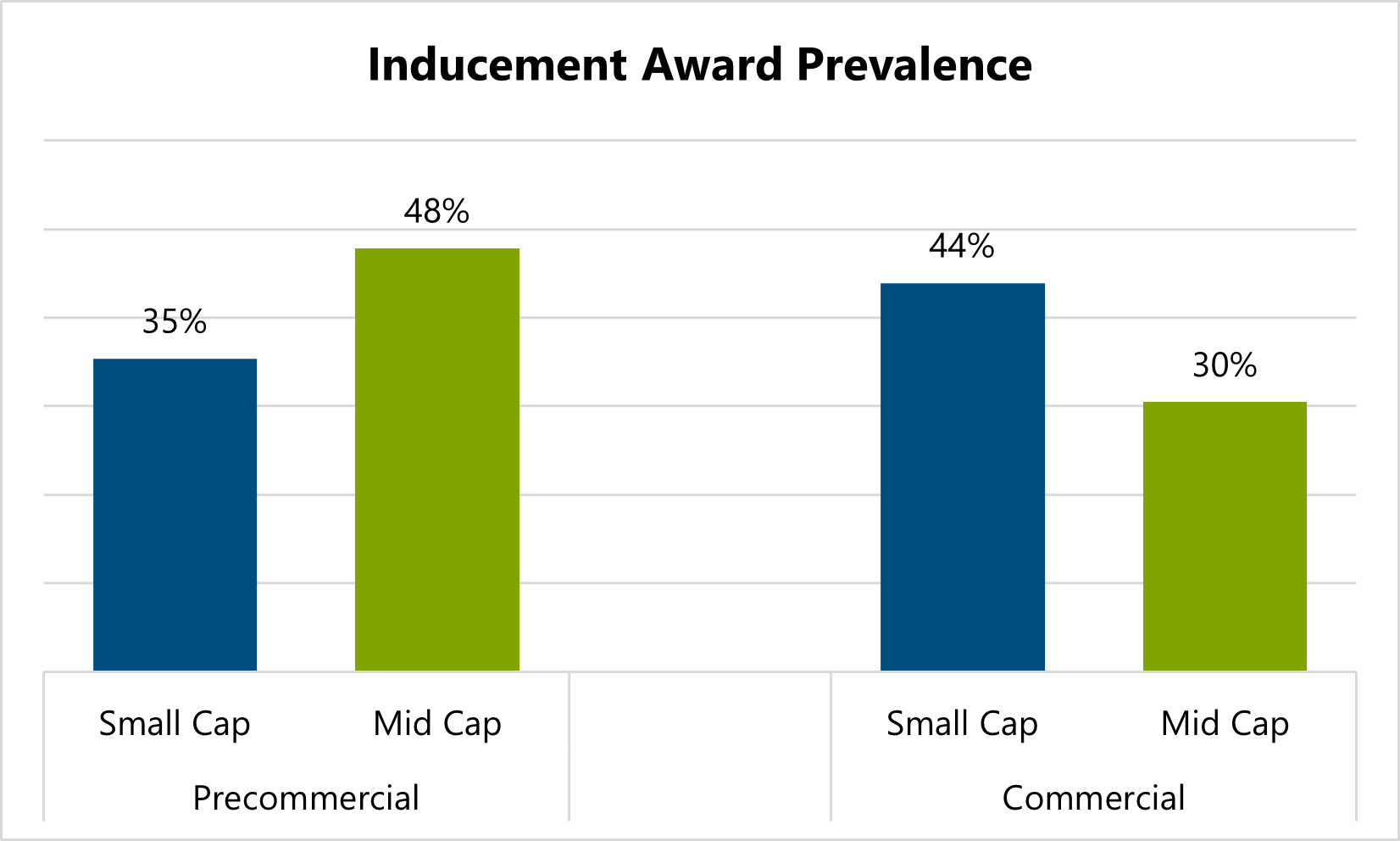
Inducement award prevalence is similar across all groups, ranging from about 30–50%. Adoption patterns can reflect differing talent and governance strategies, with usage more likely among companies scaling for later-stage development or commercialization.
Market data suggests that many precommercial companies use the inducement exemption to maximize the benefits of evergreen provisions in their equity plans. An evergreen provision provides for an annual increase in the share pool of the shareholder-approved equity plan, typically by 4–5% of outstanding shares each year. Many companies deploy strategies, including using inducement awards, to run these evergreen plans to full term to delay needing public company shareholders to approve a new pool or plan.
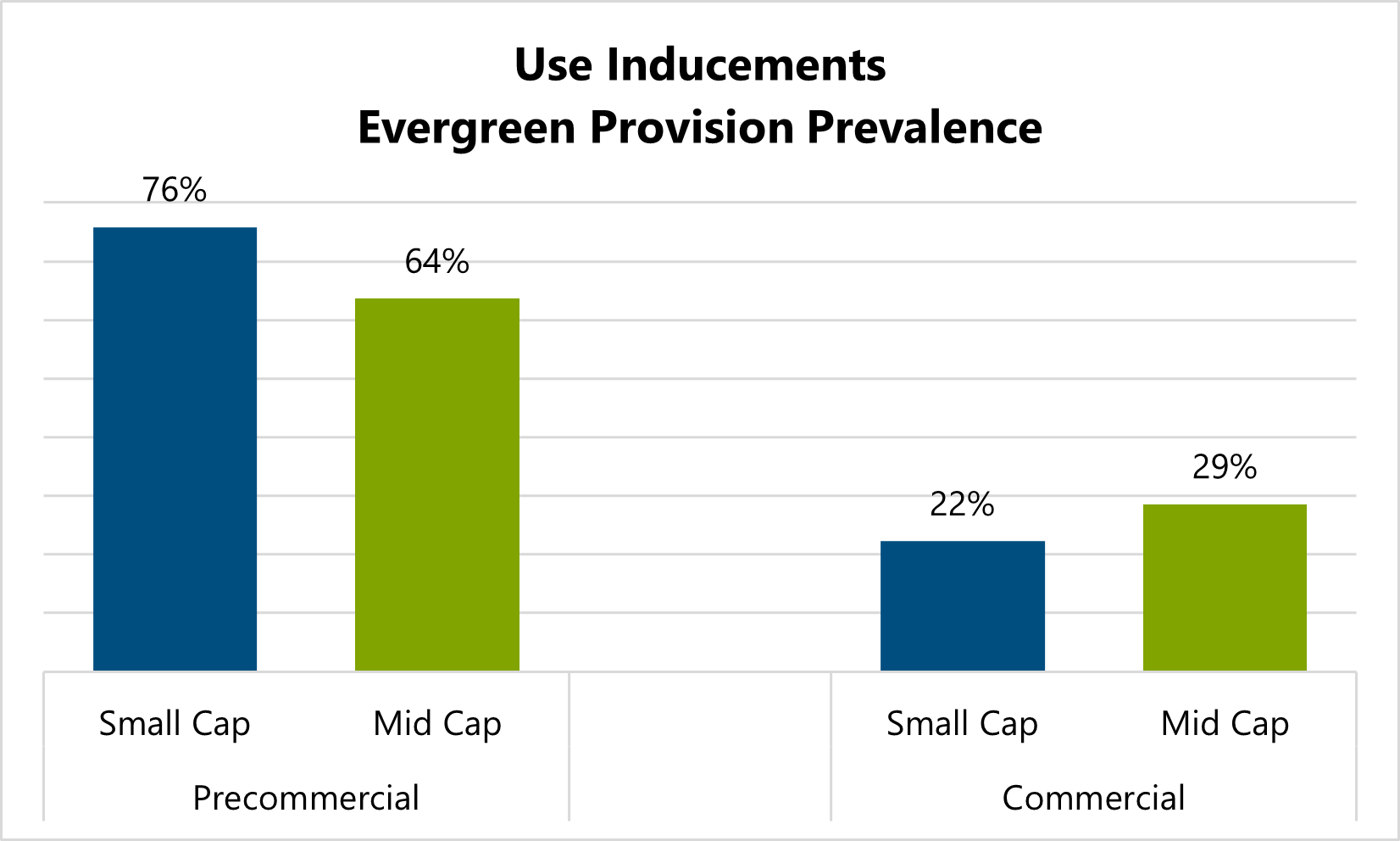
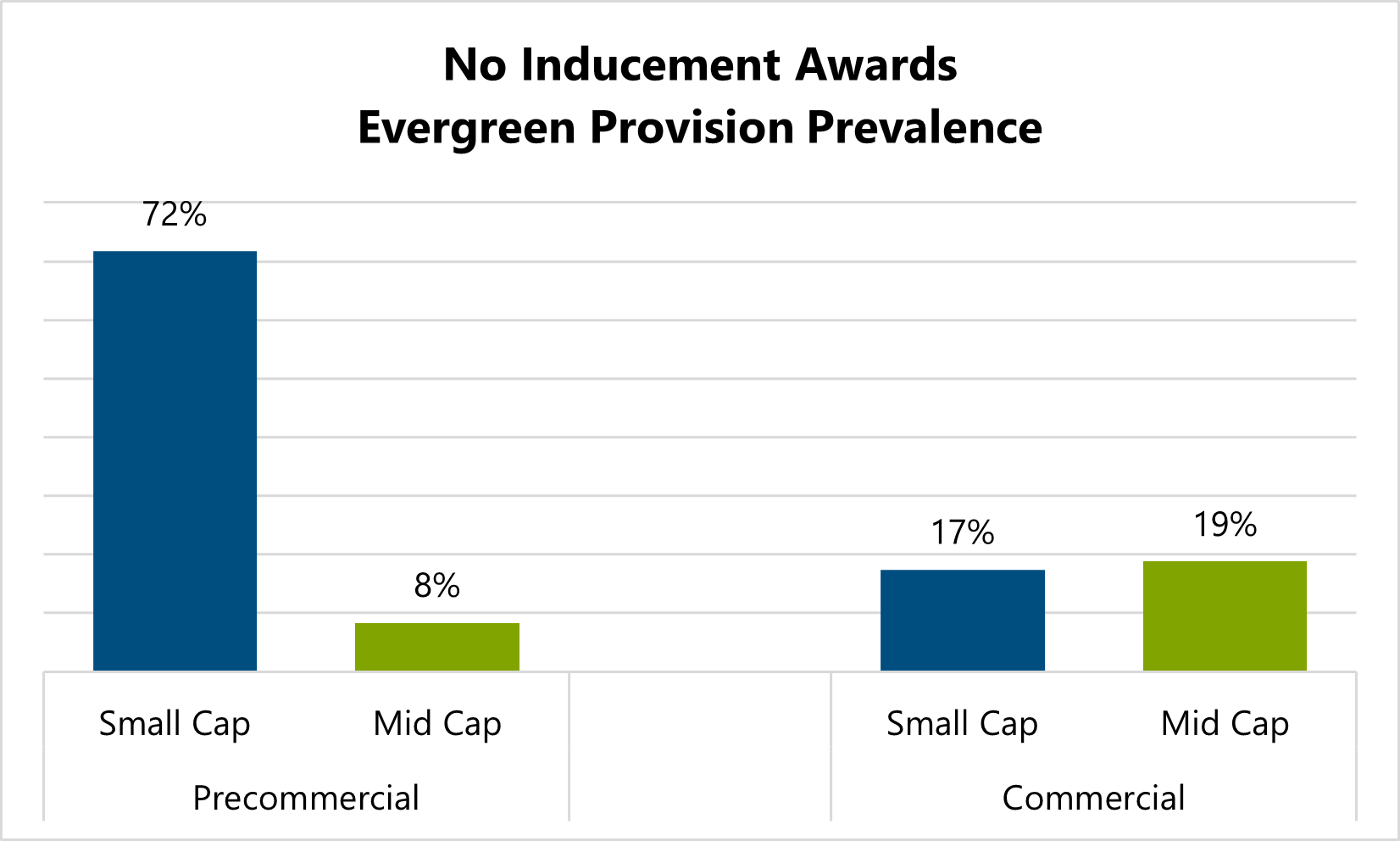
The charts above, which show the difference in inducement award usage between companies with and without evergreens, highlight that the most notable difference in practice is for the precommercial mid-cap companies. Mid-cap companies with evergreen provisions were far more likely to use the inducement exemption than those without an evergreen provision. This group of companies is likely to face the greatest pressure on share burn rates and adopts the inducement award strategy to extend the life of the evergreen plan.
As companies mature and establish a cadence of seeking shareholder approval of new plans without evergreen provisions, they are more likely to budget for expected hiring needs in sizing plan proposals. As public company shareholders will consider all grant activity and total dilution in evaluating proposals, using inducement awards can become a less attractive alternative.
The precommercial small-cap group was the most likely to use the inducement exemption on a one-off basis for a single executive hire, with seven such instances. Across the other groups, broad usage of the inducement exemption was common as companies seemingly funded all new-hire activity this way. Press releases commonly disclosed bunches of hires and aggregated total awards to recipients without providing individual details.
Key Considerations for Companies
As inducement award usage becomes more prevalent, companies should carefully evaluate several important considerations:
- Burn rate and dilution: Although inducement awards are granted outside shareholder-approved plans, they still contribute to total equity usage. Over-reliance on inducement awards can elevate burn rate and dilution metrics, potentially impacting future equity plan approvals.
- Share pool strategy: Inducement awards can be an effective tool for managing share reserves—but only as part of a broader, intentional equity strategy. Companies should model the expected life of their remaining share pool under different hiring and grant scenarios.
- Governance and optics: Even in the absence of formal shareholder pushback, governance optics matter. A significant or sustained shift toward inducement awards—particularly for broad-based hiring—could eventually attract greater scrutiny.
- Disclosure and transparency: Press release disclosures are required, but companies should also consider how inducement awards are framed in proxy disclosures, 10-K filings, and investor communications, particularly if usage becomes material.
- Anonymity and hiring patterns: In organizations with limited hiring volume (e.g., only a few hires per month), inducement award disclosures may reduce anonymity internally and signal externally how large awards may be at non-executive levels of the organization.
What’s Next for Inducement Awards and Equity Plan Strategy
Inducement awards have become a valuable—and increasingly common—tool in the biopharma compensation toolkit. Their flexibility makes them particularly well-suited to an industry characterized by rapid growth, talent competition, and evolving capital constraints.
However, as usage expands, companies should remain mindful of the broader implications. What began as a targeted exception is, in some cases, becoming a core component of equity strategy. That evolution may ultimately invite closer attention from shareholders and proxy advisors.
For now, inducement awards represent a pragmatic solution—but one that should be used thoughtfully, with a clear understanding of both their benefits and their long-term impact.