
Article | Mar 2026
Security, DEI, and Tariffs: Executive Compensation Insights from Late 2025 and Early 2026 Proxy Filers
A review of 37 S&P 500 proxy filings shows continued growth in CEO security perquisites, evolving language around ESG and DEI, and limited tariff impacts on executive pay.


As a follow-up to last year’s review of the first 100 S&P 500 proxy filers in 2025, Pearl Meyer examined executive compensation disclosures from 37 S&P 500 companies whose fiscal year ended between August and November 2025 and who filed shareholder proxy statements by February 6, 2026. Our focus was on examining trends related to current topics of interest among compensation committees.
Pearl Meyer’s early 2026 review identified three notable findings, the first two of which continue the trend identified in our 2025 review while the third is new for 2026.
- Increasing CEO Security and Aircraft Perquisites
In addition to increased prevalence of security and travel-related perquisites, we found that median security and aircraft perquisite values for same incumbent CEOs also increased 16% and 31%, respectively. - DEI- and ESG-Related Adjustments
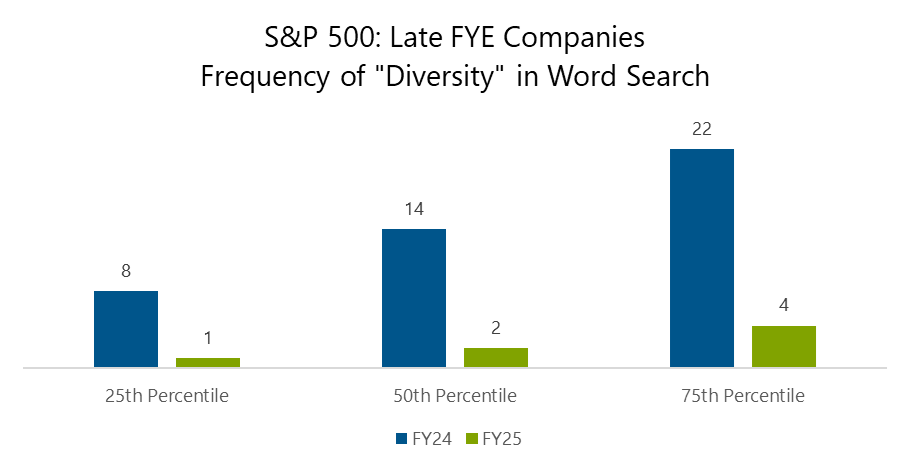
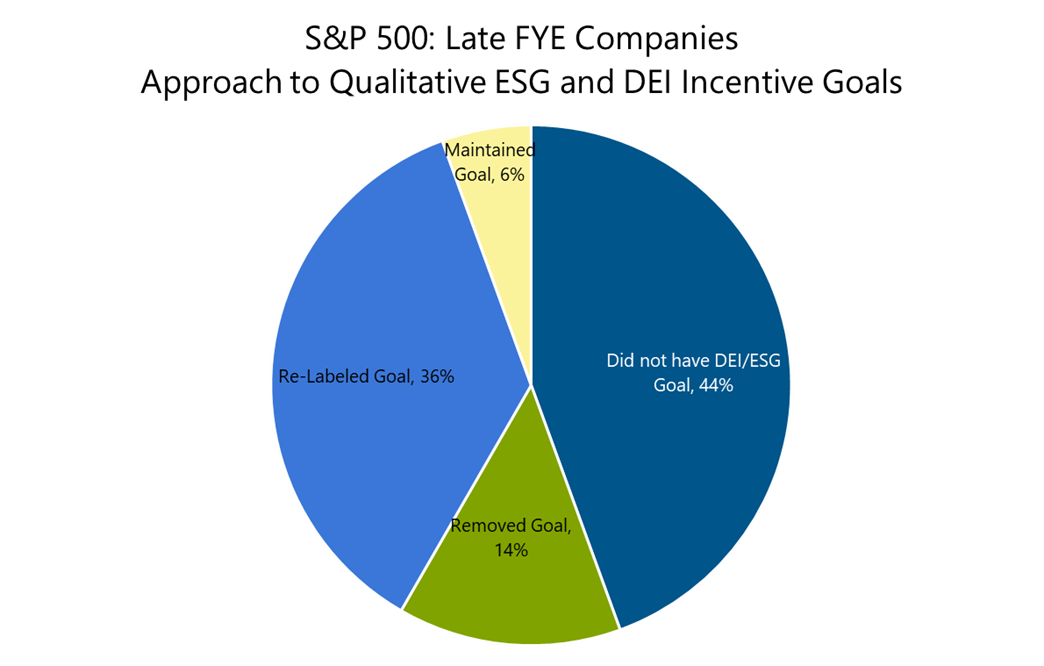
We found that 22% of companies eliminated the word “diversity” from their proxy statements. In addition, roughly a third of companies with goals related to environmental, social, and governance (ESG) or diversity, equity, and inclusion (DEI) removed or "re-labeled" those programs while maintaining the overall spirit of the initiatives. - Minimal Impact of Tariffs on Executive Pay
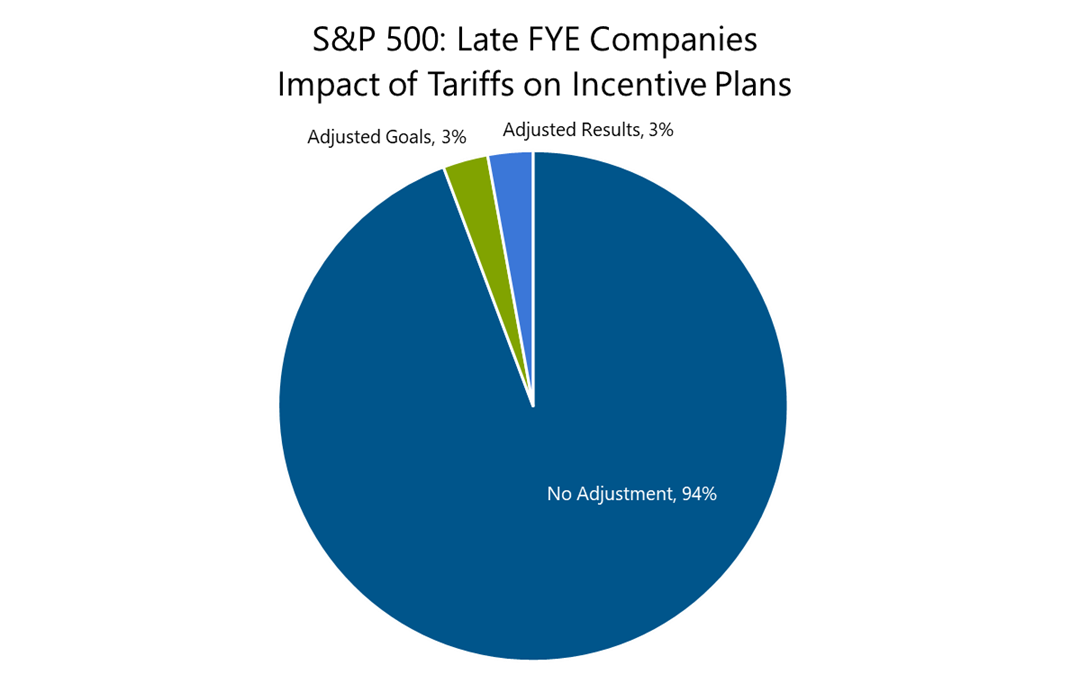
The US and many other countries imposed a number of tariffs after fiscal year 2025 incentive goals were set, but we found that only 6% of companies adjusted goals or outcomes to offset the impact of tariffs on executive compensation.
Overall, companies appear to be responding to a changing external environment by placing greater emphasis on risk oversight, evolving disclosure practices, and careful use of discretion.
CEO Security and Aircraft Perquisites Continue to Increase
Following the murder of UnitedHealth’s CEO in late 2024, public company boards took action to evaluate executive security risks and implement security measures where needed. In terms of security and aircraft perquisites, the charts below demonstrate that companies with late 2025 fiscal years showed an increase in both the prevalence and value of these perquisites.
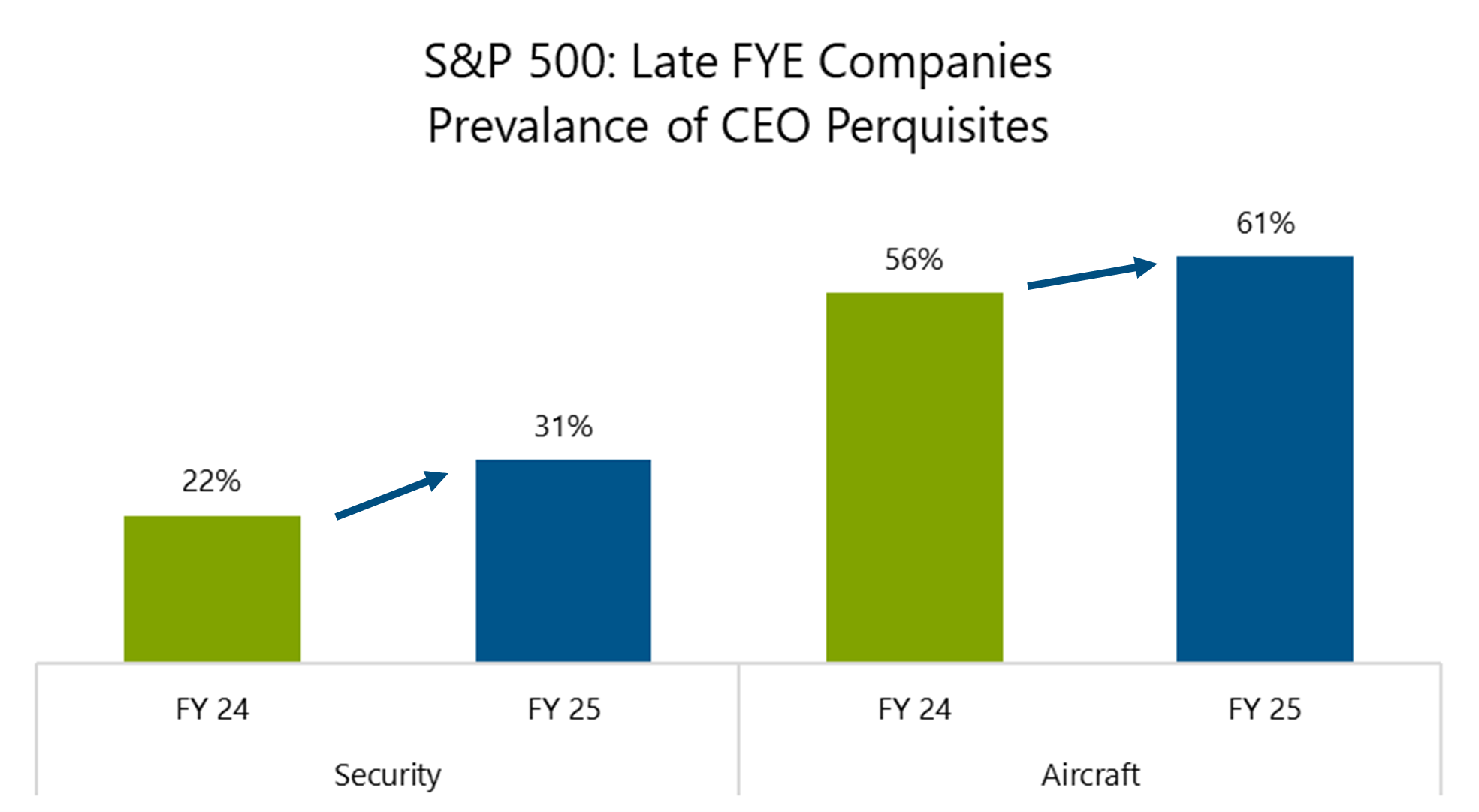
As shown above 31% of companies mentioned security perquisites, up from 22% last year, and 61% of companies mentioned aircraft perquisites, up from 56% last year. In addition, the median value of each increased by 16% and 30%, respectively (as shown below).
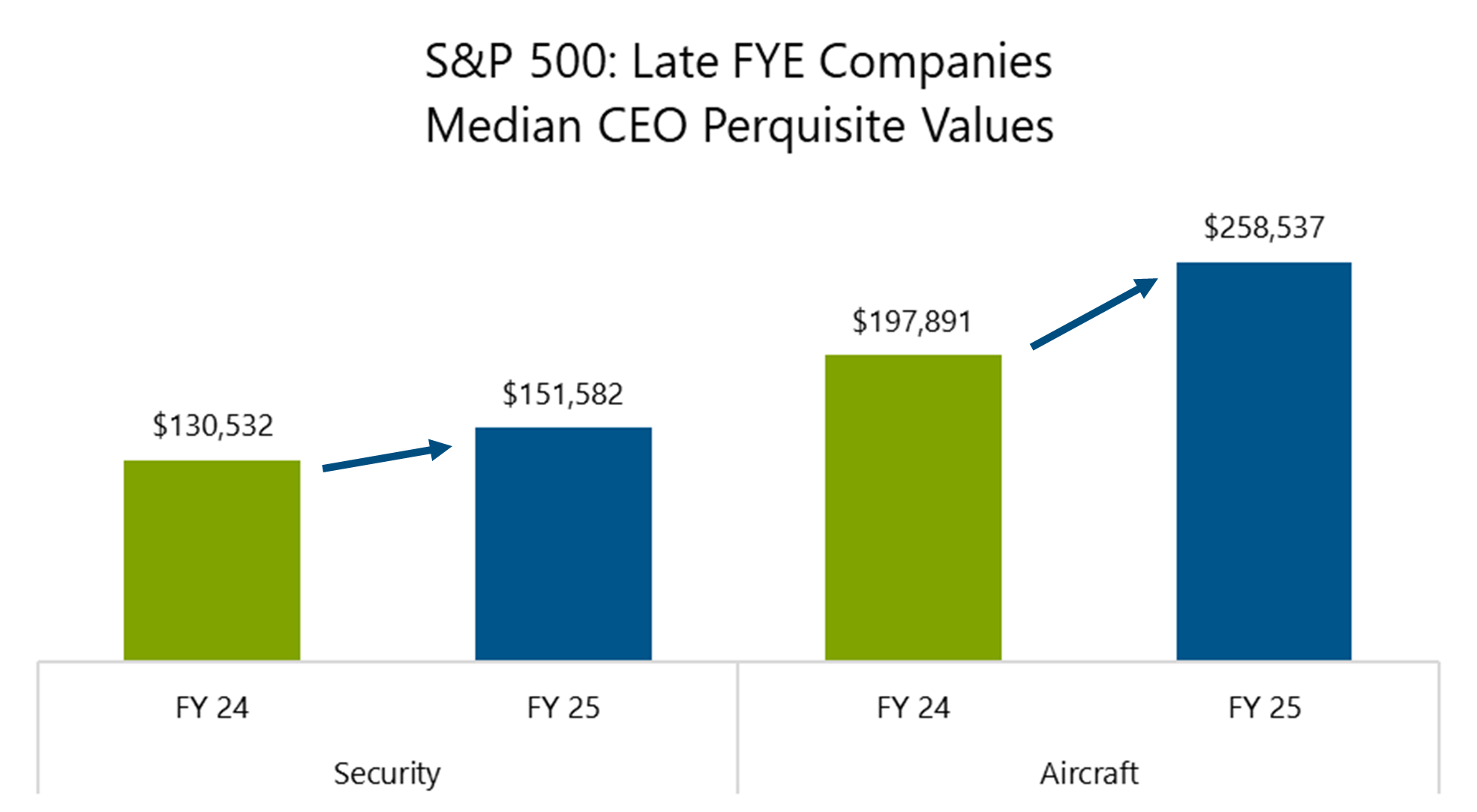
In conjunction with increasing prevalence and value of security and aircraft perquisites, we saw a shift in disclosures explaining these perquisites are part of an integrated protection plan rather than a convenient benefit. Specifically, many companies ground the decision to provide security and aircraft benefits in third-party security assessments and identified risk factors. In some cases, companies go further, stating that certain protections are required.
Together, these findings suggest that security is being increasingly framed as a board-level governance and risk issue, rather than a discretionary benefit, with corresponding rising investment levels. This may represent a quickly evolving narrative, given that Pearl Meyer’s December 2025 Executive Security Quick Poll of 250+ companies found that, in practice, many organizations are still behind the curve in formalizing their approaches.
For instance, that poll revealed 66% of respondents were spending less than $10k per year on CEO security, a concentration that seemingly reinforced that many companies treat security as an occasional cost rather than a comprehensive year-round program. The poll also found that 53% of respondents include private air travel in their CEO’s security program (as compared with the 61% figure in our early 2026 review). It will be interesting to see if the prevalence increases as more companies file proxies in 2026. We expect there to be variance in prevalence across different company sizes and industries, with larger companies and consumer-facing companies likely disclosing higher prevalence and associated values of security-related benefits.
Rebrand of ESG and DEI Remains Prevalent
Companies are continuing to move away from using DEI-related measures in executive incentives. There has been a notable decrease in the prevalence of the word “diversity” in proxy statements, as illustrated in the chart below.
Additionally, there has been a shift in the use of qualitative ESG and DEI goals in incentive plans. 14% of companies removed a DEI or ESG goal and 36% of companies “re-labeled” a DEI or ESG goal. Among our sample, only 6% of companies maintained a diversity-related goal in their incentive program. This compares with our study last year that found among the first 100 S&P 500 proxy filers, 35% had diversity as an element of their incentive program for 2024.
Examples of “re-labeling” goals include one S&P 500 company shifting the phrasing in its strategic incentive plan goal from “Diversity & Inclusion” to “Talent Strategy.” Additionally, another company pivoted from “diversity, equity, and inclusion” to “environmental and human capital” metrics in its CEO incentive compensation disclosure.
Generally, these shifts suggest that while the underlying priorities around human capital and sustainability may endure, companies are increasingly reframing how these objectives are articulated and incorporated into executive compensation.
Tariffs Had Minimal Impact on Executive Annual Incentive Plans
Among S&P 500 companies with late 2025 fiscal years, we found that 94% did not adjust for the impact of tariffs on fiscal 2025 executive annual incentives. In the limited cases where companies did adjust for the impact of tariffs, practice was mixed on adjusting goals versus adjusting actual results. It is possible that some companies made adjustments for broader employee populations and not for executive officers, which avoids disclosure. Proxy disclosure of the use of positive discretion to adjust executive incentives could lead to scrutiny from investors and proxy advisors whereas adjustments below the executive level are not disclosed and thus not subject to scrutiny.
The recent Supreme Court ruling that President Trump did not have the authority to impose tariffs, and the resulting obligation to refund tariffs paid, make this matter even more challenging to navigate. Outside of companies that were significantly impacted, we expect to see relatively little use of discretion. However, we do expect to see more companies incorporate tariffs as a potential adjustable factor when setting goals for 2026, which they did not have the opportunity to do for 2025.
These Statements Provide Only an Early Look
Among the 37 proxy statements reviewed, companies appear to be taking a cautious approach to discretion while assessing how personal safety concerns, policy changes, and geopolitical risks may influence future incentive goals. As additional companies file proxies throughout 2026, these early signals may help compensation committees anticipate how evolving risks could shape executive pay design and disclosure.