
Article | Aug 2026
Where Early-Career Hiring Is Growing—and What Employers Are Paying
Organizations are rapidly expanding intern programs, while modestly increasing college graduate hiring and largely holding pay steady.

College graduates and interns remain an important source of talent for organizations across industries, particularly as employers seek to build pipelines for future workforce needs. Hiring and compensation trends among early-career employees can provide valuable insight into changing labor market conditions, shifts in demand across academic disciplines, and evolving recruiting practices.
Data from Pearl Meyer’s 2026 College Graduate & Intern Compensation Survey reveals a market characterized by increased hiring activity alongside more moderate compensation growth, suggesting a different dynamic than employers have experienced in recent years. The data also reveals a notable shift in the early-career labor market, as shown in pay programs for more than 17,000 college hires at 163 participating companies, and rates for more than 18,000 intern positions.
Hiring activity increased for both college graduates and interns, while compensation levels remained relatively stable. After several years characterized by significant movement in both hiring demand and pay levels, the market appears to be settling into a more measured early-career labor market. While hiring activity is strengthening, particularly for interns, compensation growth is moderating.
Hiring Is Recovering, but Not Equally Across Talent Segments
After declining in 2025, hiring activity increased in 2026 across both graduate and intern populations. However, the rebound was much stronger for interns.
Graduate hiring increased a modest 6.7% from the prior year, but remained below 2024 levels. Internship hiring, by contrast, experienced substantial growth with a 29.5% increase over the prior year, and exceeded hiring volumes reported in both 2024 and 2025. Intern hiring represented the strongest area of growth among early-career talent categories.
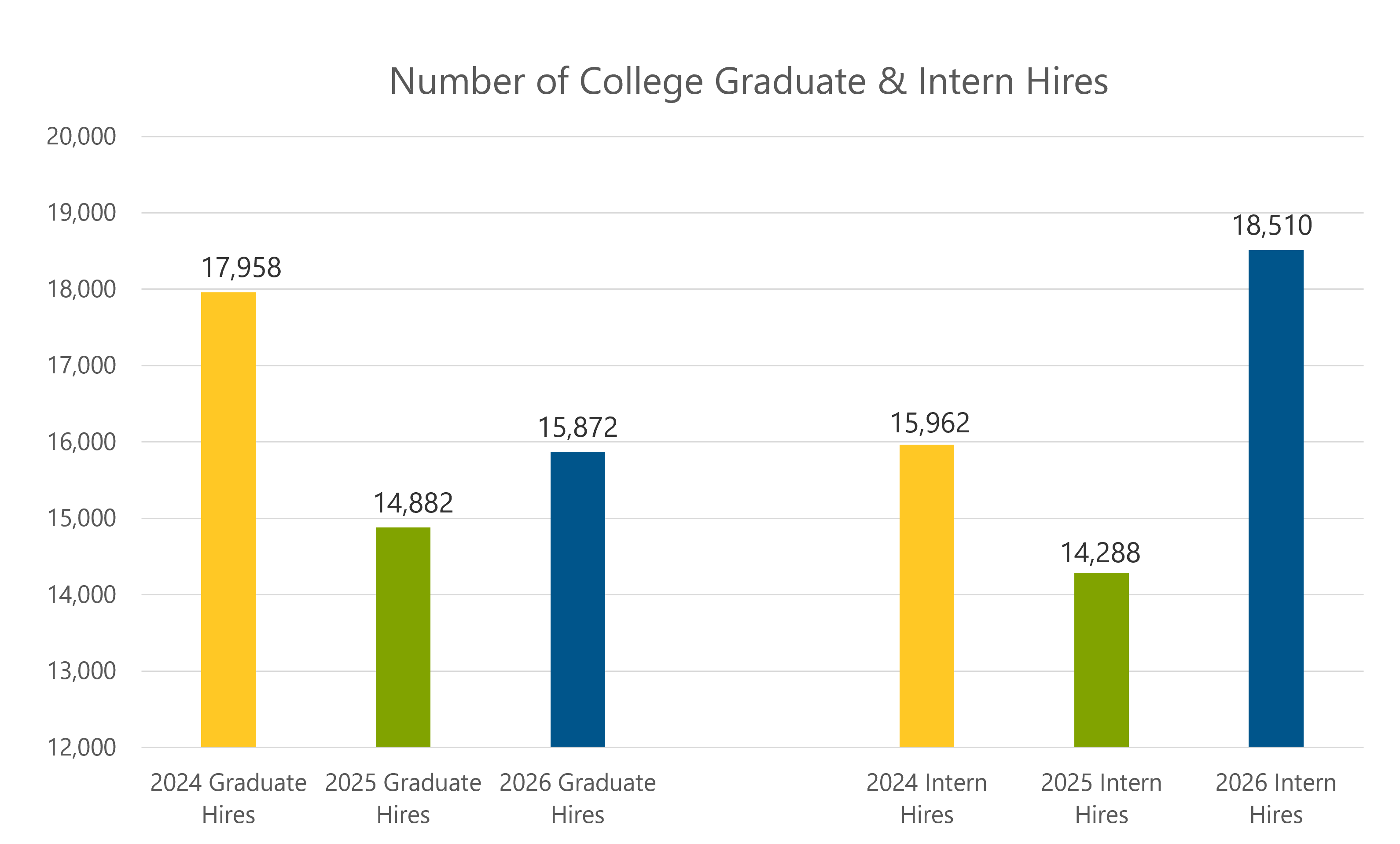
The difference between graduate and intern hiring is one of the more notable findings in the survey data. While organizations expanded hiring activity overall, much of that growth occurred through internship programs. Across the three-year period, intern hiring demonstrated greater volatility but also stronger growth momentum than full-time graduate hiring.
Compensation Has Stabilized Following Several Years of Growth
While hiring activity increased in 2026, compensation levels showed little movement.
Average starting salaries for college graduates remained largely unchanged from the prior year, following stronger increases observed between 2024 and 2025. Intern hourly rates followed a similar pattern, with only modest increases reported in 2026.
The combination of increased hiring and stable compensation represents a departure from patterns observed in recent years. During periods of heightened competition for talent, organizations frequently increased starting salaries and intern pay rates to remain competitive. The 2026 survey results suggest that compensation growth has moderated, even as demand for early-career talent remains strong.
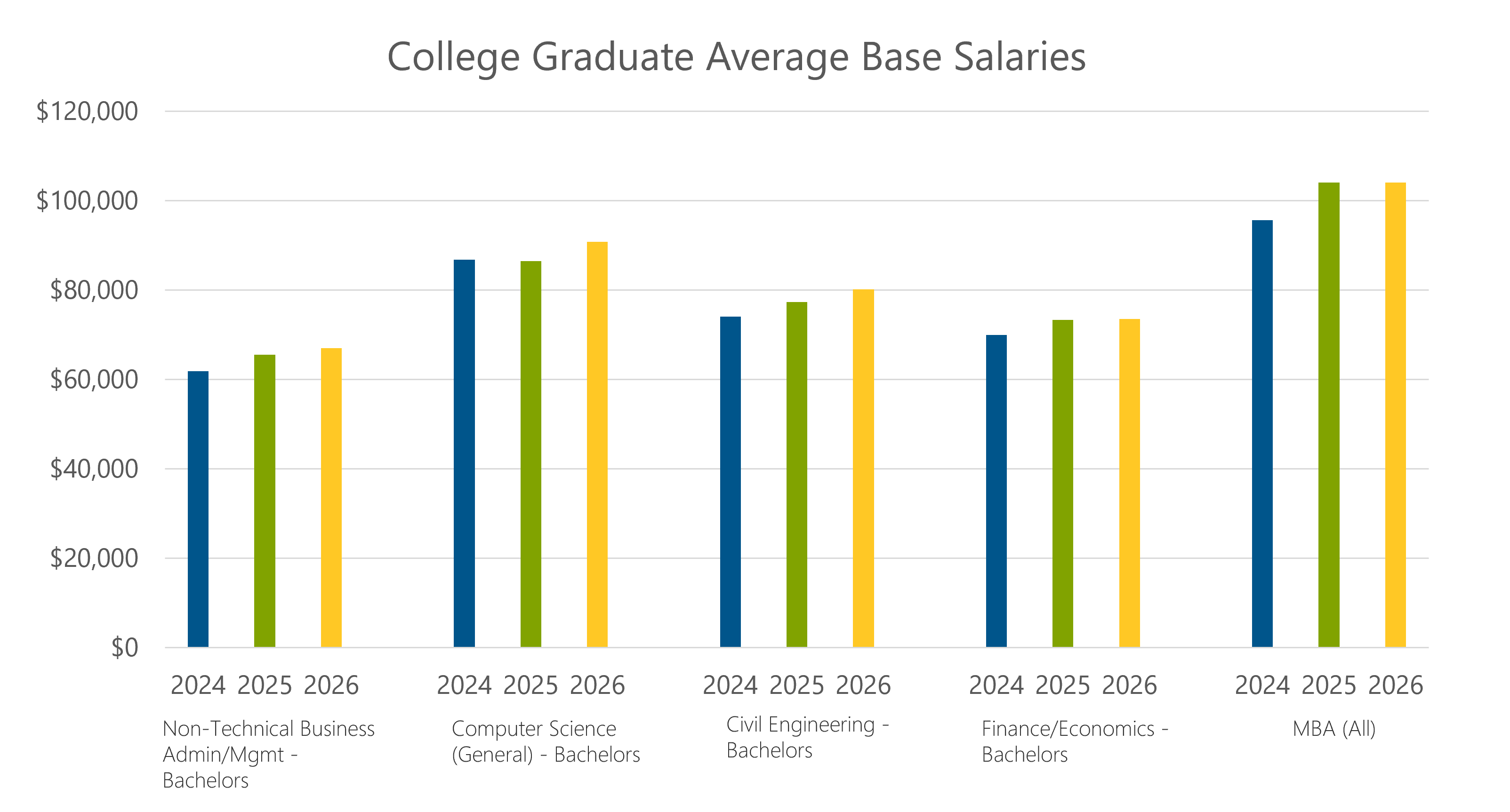
Notably, the stabilization in pay was observed across both graduate and intern populations, indicating that the trend extends beyond any single segment of the market. However, stable market averages do not necessarily mean that every employer’s pay program remains competitive. Organizations should continue assessing compensation by discipline, position, and talent market rather than relying solely on overall trends.
Hiring Demand Is Shifting Across Academic Disciplines
Although overall hiring increased, demand varied considerably by field of study.
Several business disciplines experienced growth in hiring volume, as did select engineering fields. Computer science, however, moved in a different direction. Hiring volumes declined compared with prior years, yet compensation levels remained among the highest reported in the survey.
This divergence highlights an important trend within the data. Hiring demand and compensation levels are not always moving together. While organizations reported fewer computer science hires, they continued to offer comparatively strong pay levels for those positions, as shown in the example of intern average hourly rates by degree below.
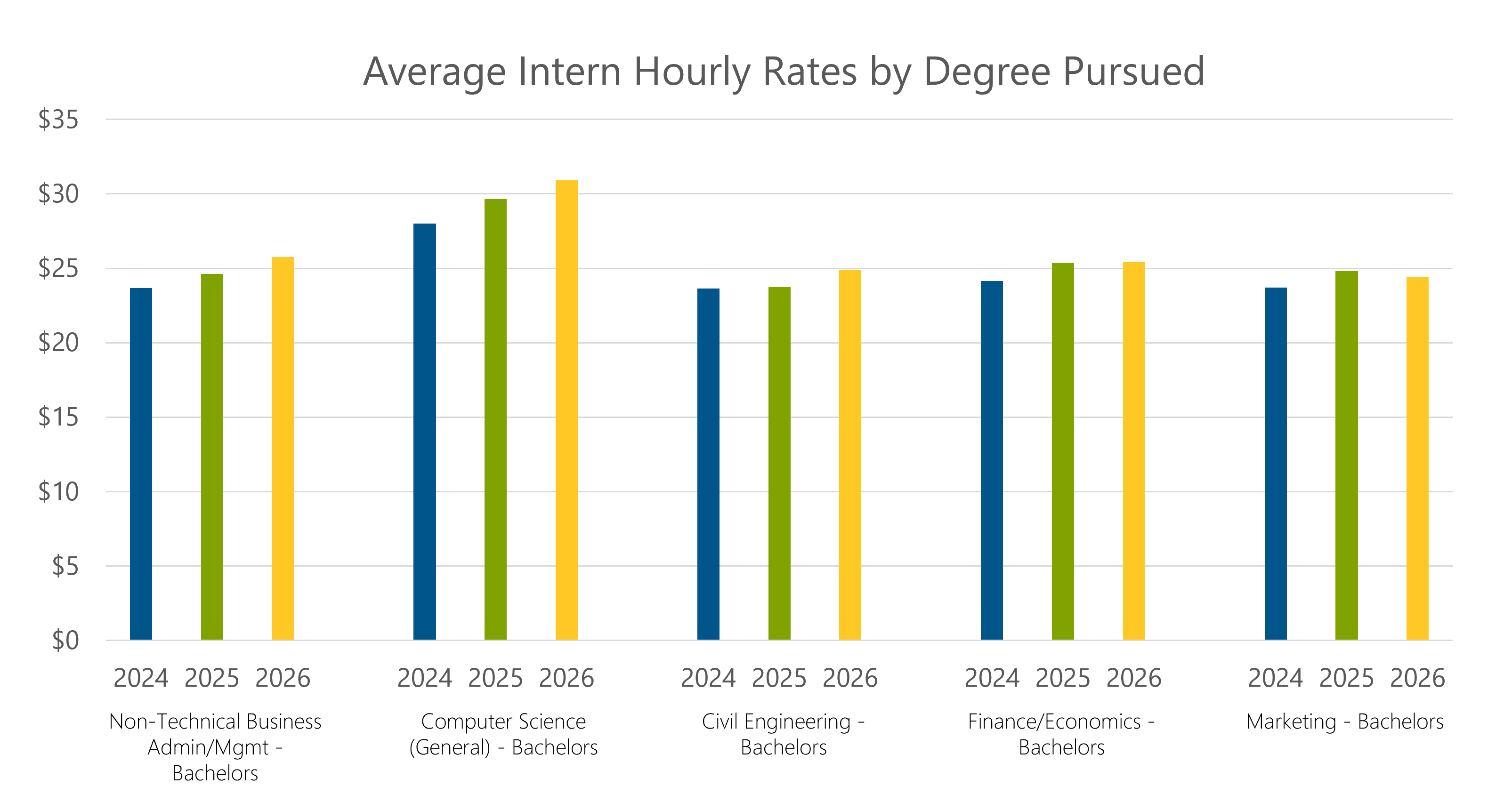
Differences across disciplines were evident throughout the survey results, reinforcing the importance of examining both hiring volume and compensation trends when evaluating market conditions. Broad market trends can mask meaningful differences across disciplines, and employers may face very different competitive conditions depending on the skills they are seeking.
Intern Programs Continue to Expand
Among all findings in the survey, the growth in internship hiring stands out most clearly.
After declining in 2025, intern hiring increased significantly in 2026, reaching its highest level during the three-year period. At the same time, intern pay remained relatively stable. Entry-level intern rates increased modestly, while compensation for more advanced interns was generally unchanged or slightly lower than prior-year levels.
The result is a market characterized by increased intern hiring without corresponding pay increases. Compared to previous years, organizations appear to be adding more intern positions while maintaining relatively consistent compensation structures.
A More Balanced Early-Career Market
Taken together, the three-year data points to a more measured, rather than uniformly stronger, market for early-career talent. Hiring activity strengthened in 2026, particularly among interns, while compensation levels remained relatively stable. Differences across academic majors persisted, with hiring demand increasing in some fields and moderating in others.
Perhaps most notably, the survey results show that growth in early-career hiring no longer appears to be accompanied by broad-based compensation increases. As organizations continue to hire graduates and interns in significant numbers, compensation trends suggest a market that is becoming more stable than the environment employers faced just a few years ago.
About the Survey
The 2026 College Graduate & Intern Compensation Survey is available exclusively from Pearl Meyer. Covering a wide range of disciplines and industries, the survey offers a comprehensive view of hiring activity, starting pay, intern compensation, and recruiting practices, helping organizations monitor evolving trends in the early-career labor market. Additional information, including the data reported and participating organizations, is available in the survey prospectus.