
Article | Jul 2026
2026 TATSS Data Shows Technician Pay Rebounding in Operationally Critical Roles
New industry data shows renewed compensation growth for experienced technicians supporting facility operations, mechanical systems, quality assurance, and increasingly complex operations.

Technical, technician, and craft roles continue to play an increasingly strategic position as organizations navigate labor shortages, operational complexity, and ongoing digital transformation. After a down year in 2025, findings from Pearl Meyer’s 2026 Technician and Technical Support Salary Survey (TATSS) show a notable resurgence in compensation growth across many technical functions, particularly in operationally critical roles tied to facility operations, electronics and mechanical systems, quality assurance, and technical support.
These increases were neither marginal nor routine annual adjustments. From 2025 to 2026, Level 3 position base salaries jumped by 14% in Facility Operations Technology, 10% in Electronics/Mechanical Technology, and 18% for Quality Assurance Technician.
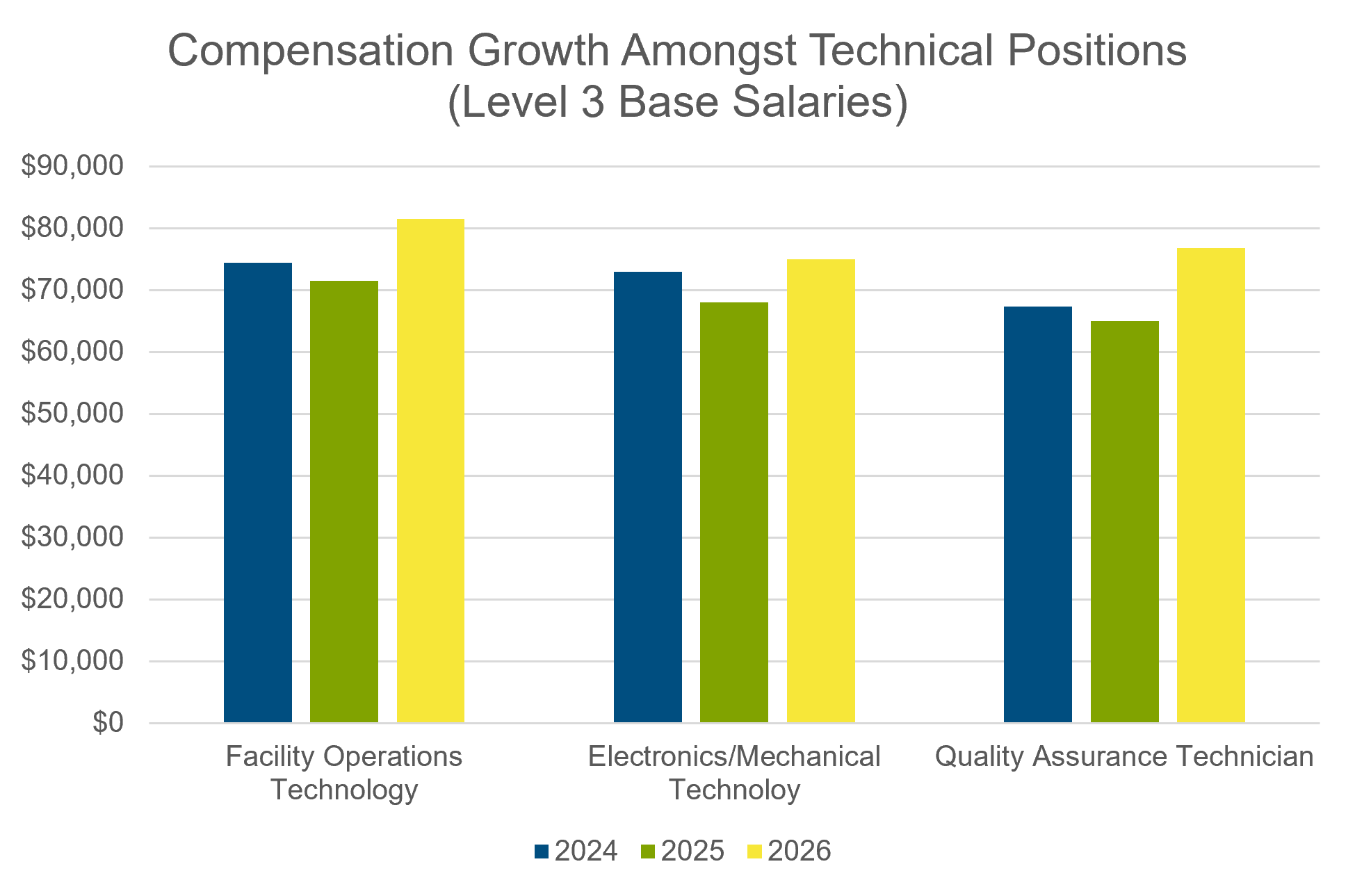
The data suggest employers are beginning to invest more heavily in experienced technical talent that can support reliability, automation, and modernized operations.
Mid-Level Talent Is Extremely Difficult to Replace
As operations become increasingly complex and technology-enabled, companies seem to be emphasizing the importance of retaining technicians skilled at troubleshooting and supporting cross-functional processes.
The strongest compensation growth in the TATSS data was often concentrated among mid-level technical roles, suggesting that employers continue to place a premium on experienced technicians who combine deep technical expertise with the ability to support increasingly complex operations. In many organizations, these employees are often the ones who understand the equipment, know the workflow, and can solve problems before they disrupt production, quality, safety, or service delivery.
Employers who recognize that mid-level technicians are central to operational reliability should ensure their pay programs recognize not only tenure, but also the practical expertise and institutional knowledge these employees carry.
Technical Talent Has Remained a Strategic Workforce Issue
The survey data consistently show meaningful compensation growth across operationally critical technician and technical support roles. That suggests organizations are no longer treating these jobs as purely tactical labor positions. They are increasingly viewed as strategic business enablers.
The survey asked participants what they are doing to attract and retain these roles in a competitive market. One popular response noted by multiple participants was a clear and promising career path. Other answers included sign-on bonuses and recognition of work. Competitive pay remained important for being able to recruit technicians.
Taken together, these responses suggest that base pay is still a critical part of the equation, but not the only one. A clear professional development path may be especially important for technical employees who want to understand how they can grow without necessarily leaving hands-on technical work behind.
Short-Term Incentives Are Sparse
Short-term incentives (STI) remain uncommon for technician and technical support roles. The survey shows that about 18% of technician/technical support staff are eligible for STI, while 82% are not.
This is often because these support positions’ work is generally viewed as operational rather than directly tied to financial results. It is also important to note that individual performance can be difficult to measure, as these positions contribute to team-based outcomes such as safety, quality, and production efficiency, uptime, and customer support.
Many technical positions are hourly, non-exempt, or represented by collective bargaining agreements. In these environments, compensation structures tend to emphasize predictable wages, overtime opportunities, and clearly defined pay progression rather than discretionary incentive awards.
Looking Ahead: Implications for Technical Talent Strategy
The 2026 TATSS data highlights continued demand for skilled technical talent, particularly experienced technicians who support increasingly complex operations. As organizations invest in automation, reliability, and operational efficiency, competition for these critical roles is likely to remain strong.
Employers need to understand which technical roles pose the greatest operational risk when they are vacant, difficult to replace, or underpriced relative to the market. Those that proactively evaluate pay competitiveness and invest in technical career development will be better positioned to attract and retain the talent needed to support future business success.
TATSS Salary Survey Methodology
Pearl Meyer publishes the annual Technician and Technical Support Salary Survey each year to provide targeted compensation insights for technical support and crafts/skilled trades professionals. This year’s survey contains about 11,500 total incumbents being divided by 10,212 technician/technical support staff and 1,174 craft roles (Electrician, Plumber, HVAC, and Carpenter) across 29 participating organizations. The report contains data regarding base salary, salary ranges, pay structure, call-in/hazard pay, and more. Learn more about purchasing the survey or participating in next year’s survey here.