
Inner Circle | Nov 2026
SEC Item 402 Proposal: A Major Simplification of the Executive Compensation Disclosure Framework
Part 1 of 3: The proposal would narrow the NEO population, streamline CD&A, and replace four compensation tables with three.

Editor's note: On November 13, 2026, the Securities and Exchange Commission (SEC) proposed sweeping amendments to Item 402 of Regulation S-K (the “Proposal”), representing the most significant reconsideration of executive and director compensation disclosure since the 2006 amendments. This three-part series explores the potential new core disclosure framework; major calculations and high-burden disclosures that would be simplified; and disclosures that would be eliminated or substantially streamlined, while underlying governance responsibilities remain.
The SEC’s Proposal would move away from a largely prescriptive executive compensation disclosure framework toward a principles-based approach that focuses on information material to an investor’s assessment of executive and director compensation. The SEC’s stated objectives are to make disclosure clearer and more useful while reducing the costs and complexity associated with preparing it.
The changes reach nearly every part of the executive compensation disclosure framework. Among the most significant are:
- Limiting named executive officers (NEOs) to the principal executive officer (PEO) and principal financial officer (PFO)
- Replacing the four principal compensation tables with three new tables organized around compensation earned, compensation granted, and the status of equity awards
- Narrowing Compensation Discussion and Analysis (CD&A) to three required topics
- Substantially revising pay versus performance (PVP) and pay-ratio disclosure
- Increasing flexibility in perquisite determinations
The Proposal is not simply a deletion exercise. Companies would still have an overarching obligation to provide material information necessary to understand the new tables, but the SEC is considering giving companies greater discretion to decide what information is material. That discretion may reduce repetitive, formulaic disclosure, but it also places greater responsibility on compensation committees and management to identify the information needed to explain the company’s compensation decisions and outcomes.
Proposed Changes: At a Glance
Topic | Principal Proposed Change |
| NEOs | Limited to individuals who served as PEO or PFO during the last completed fiscal year. |
| CD&A | Require discussion of three core topics and eliminate the list of 15 illustrative topics. |
| Primary Compensation Tables | Replace the Summary Compensation, Grants of Plan-Based Awards, Outstanding Equity Awards, and Option Exercises/Stock Vested tables with Earned Compensation, Granted Compensation, and Status of Equity Awards tables. |
Number of NEOs: Replaces Five (or More) with Two
Under the Proposal, NEOs would consist only of individuals who served as the PEO or PFO, or acted in a similar capacity, during the last completed fiscal year. This would generally reduce the NEO population from five or more executives to two. All individuals serving in the PEO or PFO role during the year would remain covered, including interim or acting executives, and situations involving co-PEOs or co-PFOs could result in more than two individuals being included.
The reduction will also affect other requirements and tables that cross-reference the new definition, including say-on-pay, certain Form 8-K disclosures (potentially reducing the number of executives for which companies need to report material compensation changes), Item 403 (potentially reducing the number of executives individually included in beneficial ownership disclosure) and Item 404 (potentially narrowing the exclusion from related-party transaction disclosure for compensation reported under Item 402).
The SEC’s rationale is that the PEO and PFO are the executives whose compensation is most likely to be material because of their central roles in corporate strategy, financial management, financial reporting, and investor confidence. It also views disclosure about the broader population—currently determined largely by relative compensation—as a source of length and cost that may not produce commensurate investor benefit.
Pearl Meyer Observations on NEO Reductions
The Proposal would materially reduce the amount of individual executive compensation information available to investors and could shift attention to the PEO and PFO as the only executives subject to the full disclosure framework.
Companies should not, however, assume that the reduced NEO definition changes the identification of employees for all other purposes, particularly when it comes to Section 162(m) covered-employee rules which expressly preserve the application of the deduction limitation to the three highest-compensated executive officers other than the PEO and PFO, regardless of whether their compensation is required to be disclosed under SEC rules. In addition, beginning with taxable years after December 31, 2026, Section 162(m) expands the covered-employee population to include five additional highest-compensated employees, whether or not they are executive officers.
Accordingly, companies will generally need to identify and track compensation for at least ten individuals for Section 162(m) purposes, notwithstanding the proposed reduction in SEC NEO disclosure to two. As such, companies will need to maintain separate processes for tax deduction, securities disclosure, and internal compensation governance generally.
That shift will also affect how companies tell their leadership and compensation story. Companies should consider whether the CD&A clearly explains the PEO’s and PFO’s distinct responsibilities, compensation opportunities, and outcomes—particularly where their roles and performance expectations differ. Depending on the company’s circumstances, voluntary context about other senior executives may still be useful—or even necessary—in explaining succession, retention, or significant leadership transitions. The narrower NEO definition should not automatically dictate the scope of the company’s broader leadership narrative.
CD&A: Eliminate the 15 Illustrative Topics and Focus on Three Required Areas
The Proposal emphasizes that Item 402 should focus on requiring material information relevant to an assessment of NEO and director compensation, and in particular, any material information necessary to understand the new Earned, Granted, and Status of Equity Awards tables.
The Proposal would revise the CD&A under Item 402(e) to require companies to discuss three topics:
- The objectives of the company’s compensation program in relation to the company’s corporate strategy.
- The material elements of the company’s compensation program and how the amounts of compensation are determined.
- Whether and, if so, how the company’s most recent say-on-pay vote influenced compensation decisions and policies.
The SEC would eliminate the current list of 15 non-exclusive example topics that may be material depending on the facts and circumstances, and streamline the CD&A instructions. Smaller Reporting Companies (SRCs) and Emerging Growth Companies (EGCs) would continue to be exempt from the CD&A disclosure requirements. The SEC’s view is that the illustrative list has encouraged companies to address every item defensively, resulting in repetitive and immaterial disclosure even when a topic is not relevant to a particular company. In fact, the Proposal cautions against boilerplate and repetitive disclosure and suggests that companies explain information presented in the tables only when additional discussion is needed to help investors understand it.
The Proposal would also add a general instruction concerning non-GAAP financial measures used as compensation targets or company-selected measures. A historical non-GAAP measure would require a quantitative reconciliation to the most directly comparable GAAP measure. A projected target measure would require a narrative description of how it is calculated from audited financial statements. In either case, the company would explain why the non-GAAP measure is more appropriate than a GAAP measure for the relevant compensation or performance purpose. The Proposal preserves the ability to omit confidential target levels where disclosure would cause competitive harm.
Pearl Meyer Observations on Streamlined CD&A Rules
The revised CD&A may be shorter and more company-specific, but it should not be less substantive. The three proposed topics provide broad organizing principles, but they do not make other compensation topics irrelevant. Many companies already explain how business strategy informs compensation design, performance expectations, and compensation committee decisions, so the substance of their narratives may change very little. There is an opportunity to reassess the CD&A with fresh eyes, preserving and improving content that helps shareholders understand the company’s compensation program and the committee’s decisions, while eliminating what no longer adds value.
A significant reduction in the number of disclosed executives would also have implications for executive compensation benchmarking. Over time, companies and compensation consultants would have less publicly available compensation information for positions other than the PEO and PFO. This would likely increase reliance on compensation surveys and other proprietary market data, particularly for specialized executive positions.
Compensation Tables: Replace the Four Existing Tables with Three New
The Proposal would replace the Summary Compensation Table, Grants of Plan-Based Awards Table, Outstanding Equity Awards at Fiscal Year-End Table, and Option Exercises and Stock Vested Table with three new tables: the Earned Compensation Table, Granted Compensation Table, and Status of Equity Awards Table. The SEC intends the new framework to distinguish compensation outcomes from compensation opportunity and to make it easier to follow equity awards over their full lifecycle.
A. Earned Compensation Table
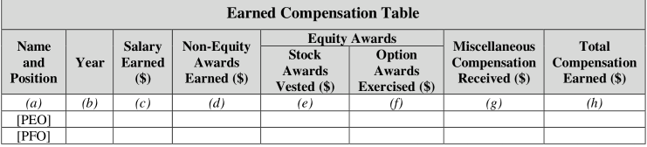
The Earned Compensation Table is intended to show compensation actually earned during the covered fiscal years. It would include salary, non-equity awards earned, stock awards when vested, options when exercised, and miscellaneous compensation received. It aims to provide a more comprehensive view of realized compensation, including value realized on equity awards granted in prior years. Stock awards would be treated as earned upon vesting; option awards would be treated as earned upon exercise.
Non-equity awards would be consolidated in one column, including annual cash bonuses, ad hoc bonuses such as signing and retention awards, non-equity incentive plan awards, and earnings on outstanding non-equity awards. The miscellaneous compensation column would include specified items such as perquisites above the applicable threshold, retirement plan service and prior-service costs, above-market or preferential earnings on nonqualified deferred compensation, life-insurance premiums, dividends or other earnings on outstanding awards, and other compensation that the company determines is material or elects to disclose. Many of the currently prescribed footnotes would be eliminated, although additional narrative disclosure would be required where material to an understanding of the reported compensation.
The table would generally cover a company’s past three fiscal years (or two, for SRCs and EGCs), subject to the proposed transition and newly-reporting company provisions.
B. Granted Compensation Table
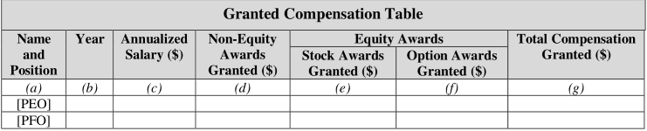
The Granted Compensation Table is intended to show the primary compensation elements granted for the covered fiscal year and the compensation opportunity contemplated by the board or compensation committee over a company's past three fiscal years (or two, for SRCs and EGCs). It would generally report salary at the annualized rate in effect on the last day of the fiscal year and non-equity awards at target. Stock and option awards would generally be reported at grant-date fair value computed in accordance with ASC Topic 718, except that the valuation would assume achievement of the target outcome of applicable performance, market and service conditions. For awards with multiple potential outcomes, target is defined as achievement of the stated target at 100% level. For awards with a binary outcome, the target outcome is that the award criteria are met and the award is fully earned.
The Granted Compensation Table would no longer require threshold and maximum potential values, although companies would have to provide additional material information when necessary to understand the award or its potential outcomes. Ad hoc cash awards, including signing and retention bonuses, would be included. Non-equity awards earned in a year before the year in which they are formally granted must be reported in the prior year, and equity awards granted in the first quarter of a given year but earned in the previous year may be reported in the previous year, subject to consistent reporting.
Pearl Meyer Observations on the New Granted Compensation Table
The proposed treatment of performance-based equity awards could produce significantly different grant-year values than investors are accustomed to seeing. Under the Proposal, equity awards would generally continue to be valued using ASC Topic 718 principles, but the valuation would assume achievement of the target outcome of applicable performance, market, and service conditions.
The impact could be particularly significant for awards subject to financial or operational performance conditions, such as revenue, EBITDA, or EPS goals. Under current disclosure rules, the reported grant-date value generally reflects the probable outcome of the performance condition. As a result, a “moonshot” award subject to an ambitious performance goal that is not considered probable of achievement may have little or no grant-date value reported in the Summary Compensation Table. Under the Proposal, the same award would be valued assuming target performance, potentially resulting in substantial Granted Compensation even where achievement of the target is considered unlikely at the grant date.
Awards subject to market conditions, such as relative TSR or absolute stock-price goals, present a different valuation issue. Under current ASC Topic 718 principles, the effect of the market condition is incorporated into grant-date fair value, typically through a valuation methodology such as a Monte Carlo simulation. Under the Proposal, the valuation would instead assume achievement of the target outcome of the market condition, which could result in a reported value that differs from the amount currently reported.
More broadly, the Proposal shifts the focus toward the compensation opportunity established by the compensation committee rather than the accounting value currently reported for the award. While this may provide a more straightforward picture of target compensation opportunity, it may also obscure meaningful differences in the difficulty of performance goals.
Two awards with similar target opportunities but substantially different levels of performance risk could produce similar reported Granted Compensation values. In fact, the Proposal provides that in the event of such a divergence, companies would be required to provide supplemental narrative disclosure to help investors understand the material difference between the reported target value and the probable outcome of the award.
C. Status of Equity Awards Table
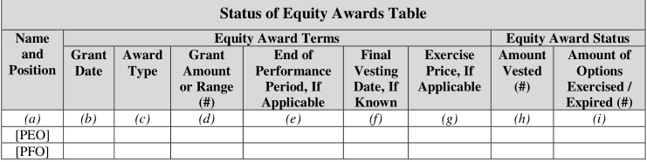
The Status of Equity Awards Table is intended to bridge the Earned and Granted tables by following each equity award from grant through vesting, exercise, or expiration. Unlike the current Outstanding Equity Awards table, it would report awards in shares rather than in hypothetical dollar values and would not require annual recalculation of market value or assumed performance outcomes. Award terms would be shown on an award-by-award basis, with the number of shares or options and any threshold, target, and maximum performance share potential clearly identified.
The table would include grant date, award type, grant amount or range, end of performance period (if applicable), final vesting date (if known), exercise price (if applicable), number of shares vested, and number of options exercised or expired. Material performance, market, and service conditions would need to be described. Equity awards are generally reported based on their status at fiscal year-end. Awards generally cease to be reported once fully vested, exercised, or expired.
Pearl Meyer Observations on the Status of Equity Awards Table
Companies will want to start thinking about modeling the effect of vesting and option-exercise timing on reported annual totals, particularly where long-term incentive awards vest in large tranches. While the Proposal may not become effective until 2029, grants made in the next few years will eventually flow through the Status Table under the new structure.
Pearl Meyer Observations on All Three Tables
The SEC’s central policy choice was to emphasize both pay opportunity and realized pay rather than combine them in one Summary Compensation Table. This is likely to be the most operationally significant aspect of the Proposal. Companies will need to map existing compensation data and disclosure processes to three different measurement concepts:
- Earned/realized compensation
- Granted compensation opportunity
- Award-level equity status
The new approach will require careful coordination among equity administration, payroll, finance, tax, human resources, and the proxy drafting team to ensure that compensation data is accurately captured and presented across the three tables.
The three tables are intended to provide complementary views of compensation and should be considered together. The accompanying narrative will be paramount to helping shareholders understand the differences between compensation granted, compensation earned, and equity awards that remain outstanding. This is particularly important because the amounts reported in each table may reflect different periods of time and different measures of value. For example, granted equity is reported at target value, compensation earned may reflect awards granted in prior years, and annualized salary may differ from salary actually earned during the year. Companies should explain material differences and timing effects, and how they relate to compensation committee decisions, rather than simply repeat the tabular disclosures.
More broadly, investors should be cautioned against interpreting any one of these measures in isolation as an indication of pay-for-performance alignment. Compensation earned in a particular year may reflect decisions and performance spanning several years, as well as executive decisions regarding the timing of option exercises. An executive could exercise options granted several years earlier, generating substantial earned compensation unrelated to current-year performance. Similarly, a PSU award could vest in one year, creating a spike in reported compensation even though the award reflects three years of performance.
Narrative disclosure will help investors understand these distinctions and, ultimately, what the reported numbers do—and do not—reveal about the relationship between pay and performance.
Effective Date, Transition, and Early Compliance
The Proposal will not affect disclosure for the 2027 proxy season. If adopted, the amendments would become effective on January 1, 2028, following publication of the final rules in the Federal Register, with mandatory compliance beginning with the first full fiscal year ending on or after that date. Companies could voluntarily comply beginning on the effective date but would be required to comply with each amended Item in its entirety rather than selectively adopting individual provisions.
Thus, if final rules are published during 2027, a calendar-year company would generally be required to apply the new rules to fiscal 2028 compensation disclosed in its 2029 proxy statement, although voluntary compliance with the complete set of new rules could begin on January 1, 2028. The SEC has solicited public comment about whether phased-in transition arrangements are needed for the new tables, including whether companies should initially disclose only one year and then phase in the additional years.
Pearl Meyer Observations on Timing
The timing is not fixed and will depend on when the final rules are published. The SEC’s illustrative January 1, 2028 effective date is not a settled compliance date, so companies should monitor the rulemaking and begin assessing potential systems impacts. It will be a particularly interesting exercise to compare reporting under current and proposed rules, keeping in mind the ability to use the new rules would not be available until at least proxy season 2028. Nonetheless, longer-term incentives granted over the next few years may not vest or be exercised until after implementation, at which point they would be reflected in the Status of Equity Awards Table.
What Companies Should Be Considering Now
No immediate changes to current disclosure practices are necessary. Companies can, however, begin assessing the potential implications of the Proposal now and, as they prepare this year’s disclosures, consider where current practices and drafting may provide a useful foundation for a transition to the proposed framework.
Compensation Reporting and Data
- Model the proposed Earned and Granted Compensation Tables using historical data, including multi-year PSUs, options, and awards with threshold, target, maximum, or binary outcomes.
- Identify the data sources, systems, and owners needed to support the new equity award reporting and reconcile information to equity administration records.
- Evaluate the impact of the narrower NEO definition on proxy disclosure, beneficial ownership reporting, and other processes, while maintaining separate Section 162(m) covered-employee tracking.
CD&A Narrative and Investor Communications
- Reassess the current CD&A narrative: What remains important to shareholders? What is repetitive or outdated? What should be retained, elevated, repositioned, or added?
- Consider how the narrative will connect business strategy, compensation design, performance measures, award opportunities, and compensation outcomes.
- Determine how the narrative will help shareholders understand the new compensation tables without simply repeating the tabular information.
Implementation and Governance
- Identify the coordination needed among legal, finance, HR, payroll, tax, equity administration, investor relations, and XBRL service providers, including any potential comment-letter considerations.
- Continue to monitor the SEC's separate May 19, 2026 Filer Status proposal, which could provide additional disclosure relief for non-accelerated filers.
Concluding Thoughts
The proposed two-executive, three-table framework would change both what companies report and how they compile it. Compensation committees should consider how earned outcomes, granted opportunities and outstanding equity awards will be presented together, and how the CD&A can explain their relationship without repeating the tables. While the rulemaking remains pending, companies can begin assessing their data sources, responsibilities, and disclosure processes without changing current proxy practices.
Part 2 of this series will cover the Proposal’s potential impacts on pay versus performance, CEO pay ratio, perquisite disclosures, and clawbacks.