
Article | May 2026
2026 Real Estate Compensation Trends: A Market Rebalancing
Insights from our 2025 Real Estate Compensation Survey reveal moderating salary growth, stronger performance differentiation, and increasing reliance on long-term incentives to retain leadership talent.



Compensation strategy across the real estate industry is shifting phases, from more broad-based expansion to targeted deployment. After several years of rapid post-pandemic pay growth driven by inflation and talent shortages, organizations are now deploying compensation dollars more selectively: prioritizing leadership continuity, capital markets expertise, and roles that directly influence enterprise performance.
Data from the 2025 Real Estate Compensation Survey (RECS) highlight this shift. Base salary growth is moderating, bonus pools remain funded but are more differentiated, and long-term incentives (LTI) are regaining importance as companies focus on retaining senior leadership and aligning pay with long-term value creation.
KEY TAKEAWAYS FROM THE 2025 RECS
|
Base Salary: Broad Moderation, Targeted Investment
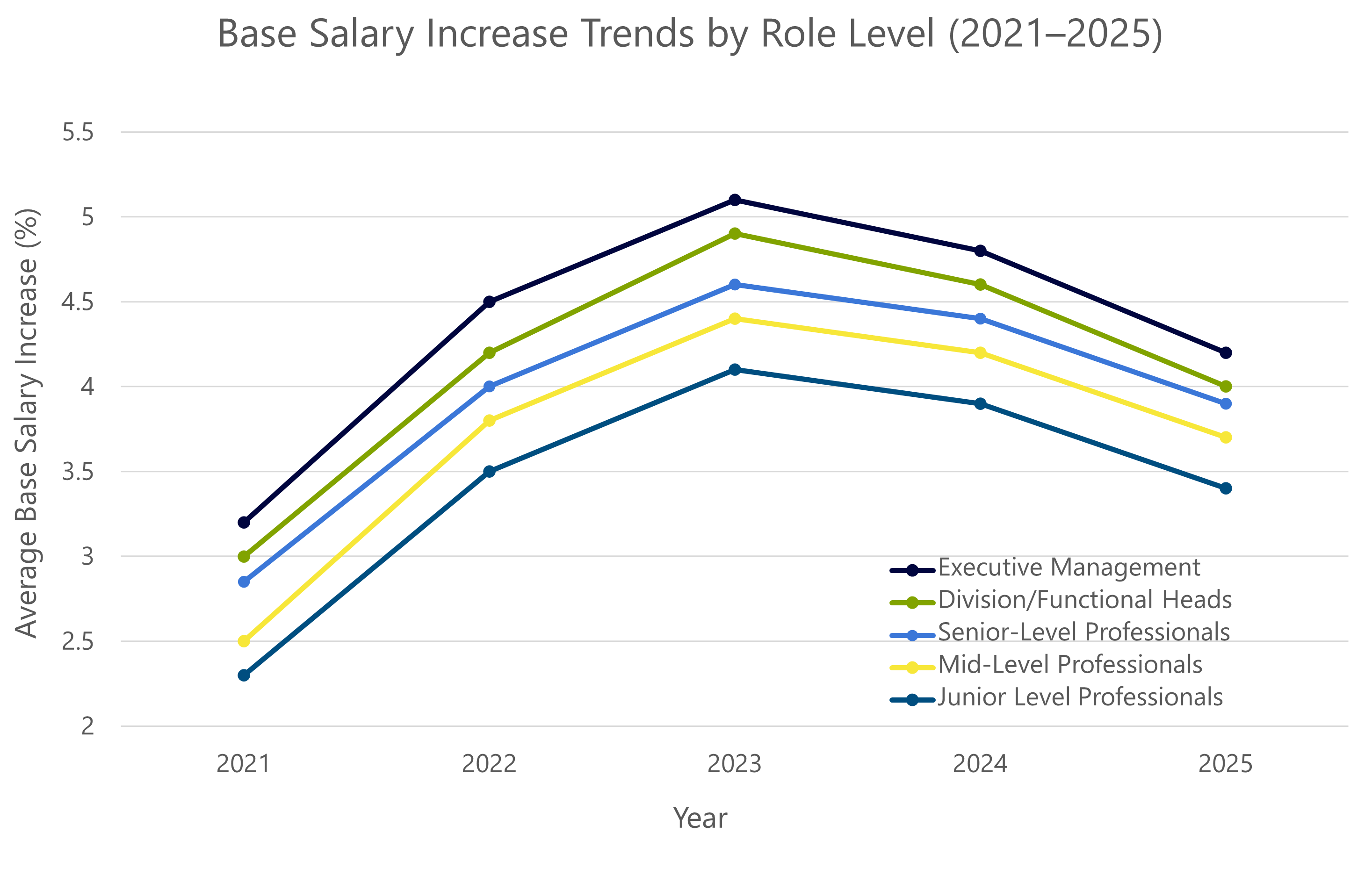
Base salary increases accelerated sharply following the pandemic and peaked in 2023. By 2025, increases have moderated across most roles as organizations return toward longer-term compensation norms. This shift reflects a move away from broad market adjustments toward more selective pay investment.
Where Salary Momentum Persists: Hot Jobs
Despite broader moderation in salary growth, salary momentum remains elevated in several job families. These roles tend to sit at the center of capital strategy, portfolio performance, and operational execution, which is shown in the salary increase patterns below.
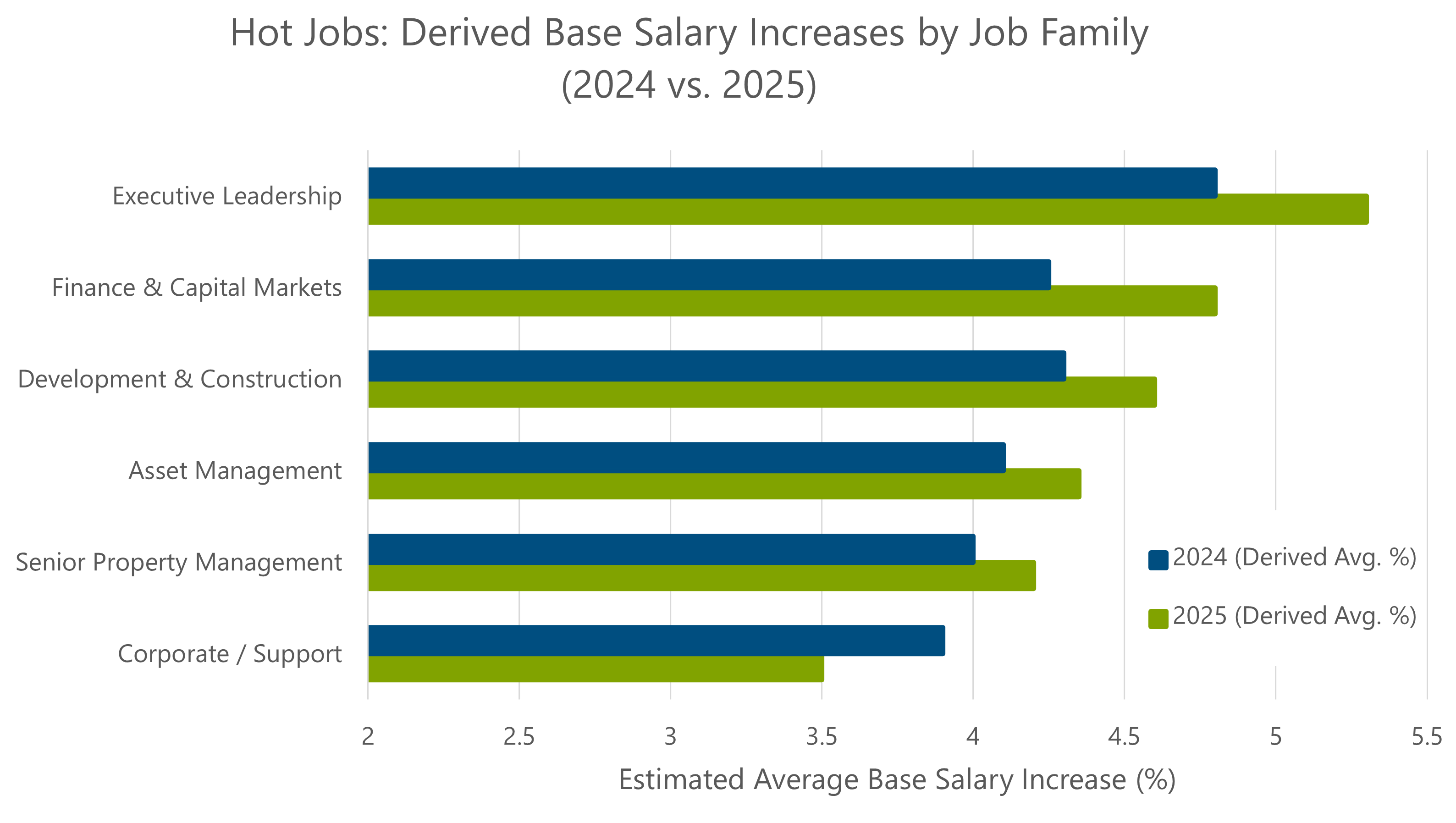
Leadership and finance roles show the strongest salary momentum, while corporate and support functions exhibit clear deceleration.
Key Drivers of Salary Momentum by Job Family
The RECS data show a clear hierarchy of salary pressure across job families—from leadership and capital markets roles at the top to moderate growth among corporate and support functions.
- Executive Leadership: Strong salary momentum reflects leadership retention risk, succession concerns, and increasing complexity in capital markets and refinancing strategy.
- Finance & Capital Markets: Debt maturities, liquidity management, and investor communication demands continue to drive demand for experienced financial leadership.
- Development & Construction: Firms pay a premium for leaders who can navigate cost escalation, entitlement risk, and supply-chain volatility.
- Asset Management: Asset managers are increasingly central to net operating income protection, operational optimization, and portfolio repositioning.
- Senior Property Management: Operational complexity and regulatory oversight sustain demand for experienced operators, though salary pressure has moderated.
- Corporate & Support Functions: Salary growth is decelerating as organizations move past the broad catch-up adjustments of recent years.
Annual Incentives: Funded but More Selective
Bonus pools increased modestly overall, but a larger share of companies reported flat payouts as organizations emphasized stronger performance differentiation.
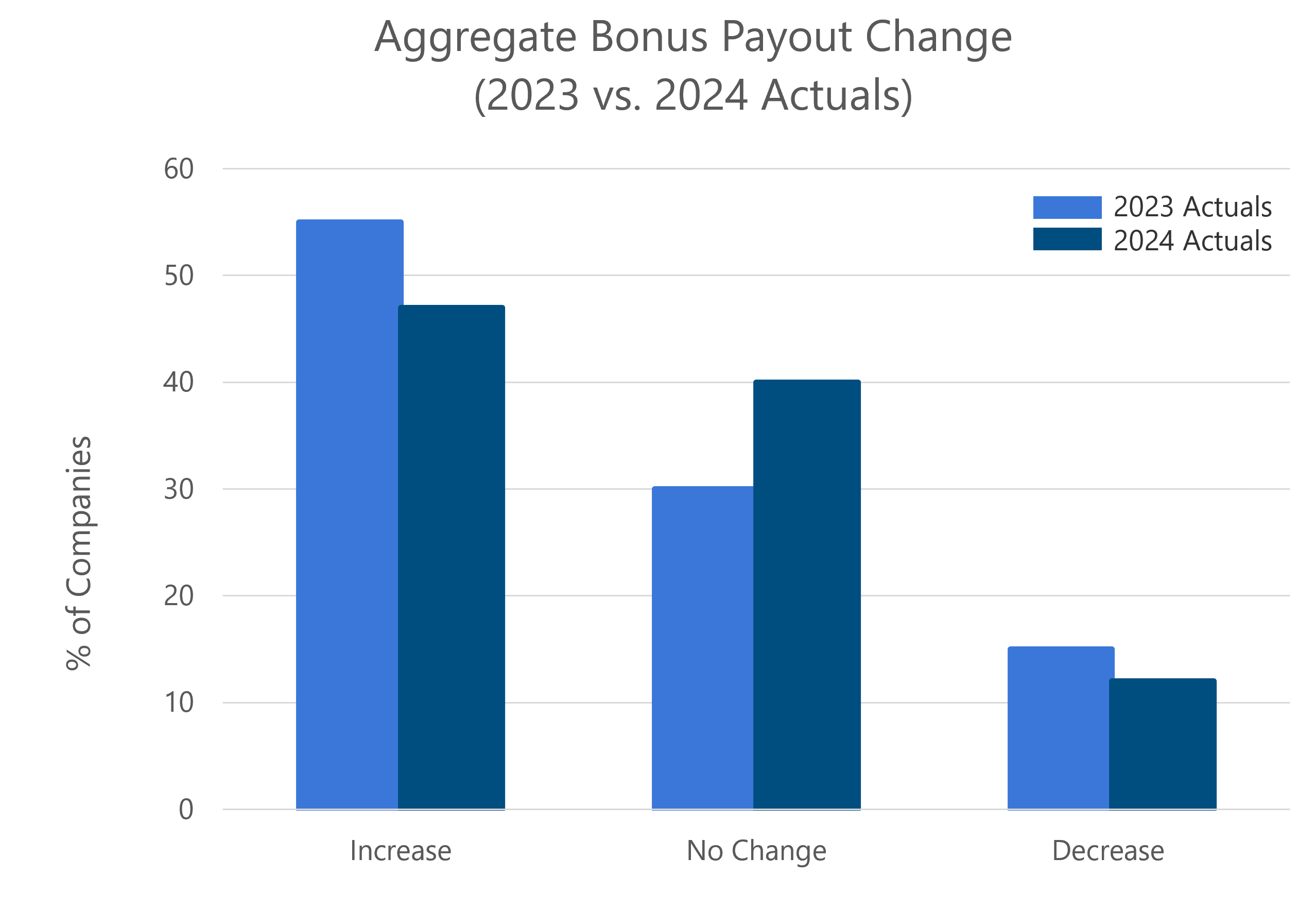
As base salary growth normalizes, organizations are relying more on variable compensation to differentiate performance. Annual incentive payouts increased modestly in 2024 relative to 2023, though outcomes varied more widely across organizations and roles.
LTI Remains Important
LTI values increased modestly in 2025, with growth concentrated among senior leadership roles.
| Ownership Type | Change in Average LTI Value (2025 vs. 2024) |
Public Companies | 5.9% |
Private Companies | 8.3% |
Private companies in particular increased LTI award values through profits interest, carried interest, and multi-year cash-based incentive designs.
Implications for 2026 Planning
The broad compensation adjustment cycle that followed the pandemic has largely run its course. Looking ahead in 2026, organizations are likely to maintain disciplined base salary growth, while focusing incremental pay investment on leadership, capital markets expertise, and execution-critical roles.
In this environment, compensation strategy is shifting from broad increases to more precise approaches—directing pay investment toward the roles that most directly protect enterprise value and drive long-term performance.
Methodology: Data are derived from the 2025 Pearl Meyer Real Estate Compensation Survey (RECS). Base salary increase estimates reflect weighted midpoint calculations applied to survey-reported increase ranges.