
Article | Aug 2026
How Banks Are Structuring Paid Time Off in 2026
New survey data show banks and credit unions are consolidating leave into PTO programs, determining employee eligibility, and managing unused time.

For many years, separate vacation and sick leave policies were the traditional approach to employee time off in the banking industry. Today, more financial institutions are adopting paid time off (PTO) programs that combine multiple types of leave into a single bank of time.
The Continued Shift Toward PTO Programs
According to Pearl Meyer’s 2026 Banking Benefits and Human Resources Policies Survey, 59.5% of participating institutions offer a PTO program, making it the most common leave structure among survey participants. This reflects a steady, significant shift toward consolidated leave programs since 2018, with adoption increasing by 19.5 percentage points, or 48.8%.
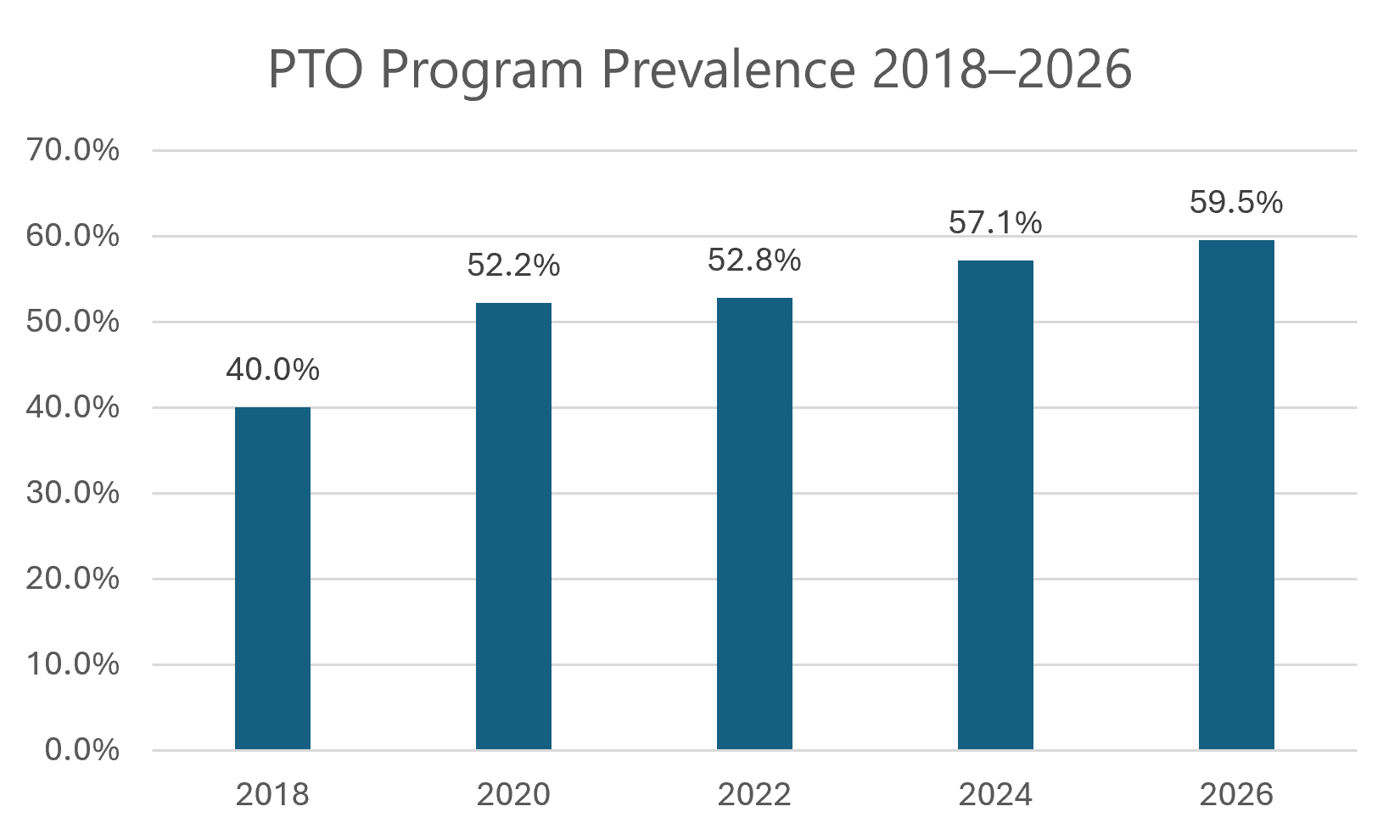
Unlike traditional programs that maintain separate balances for vacation, sick leave, and sometimes personal days, PTO combines most or all of that time into one balance. Employees can use the available time off according to their personal or family needs.
For employers, PTO programs can simplify administration by reducing the need to manage multiple leave categories and providing a more consistent framework for time-off policies across the organization.
What Banks Include in PTO
Vacation, sick leave, and personal time are the most common components of bank-related PTO programs. In addition, 35.4% of participating institutions include bereavement leave, up from 29.9% in 2024. The chart below shows the types of leave commonly included.
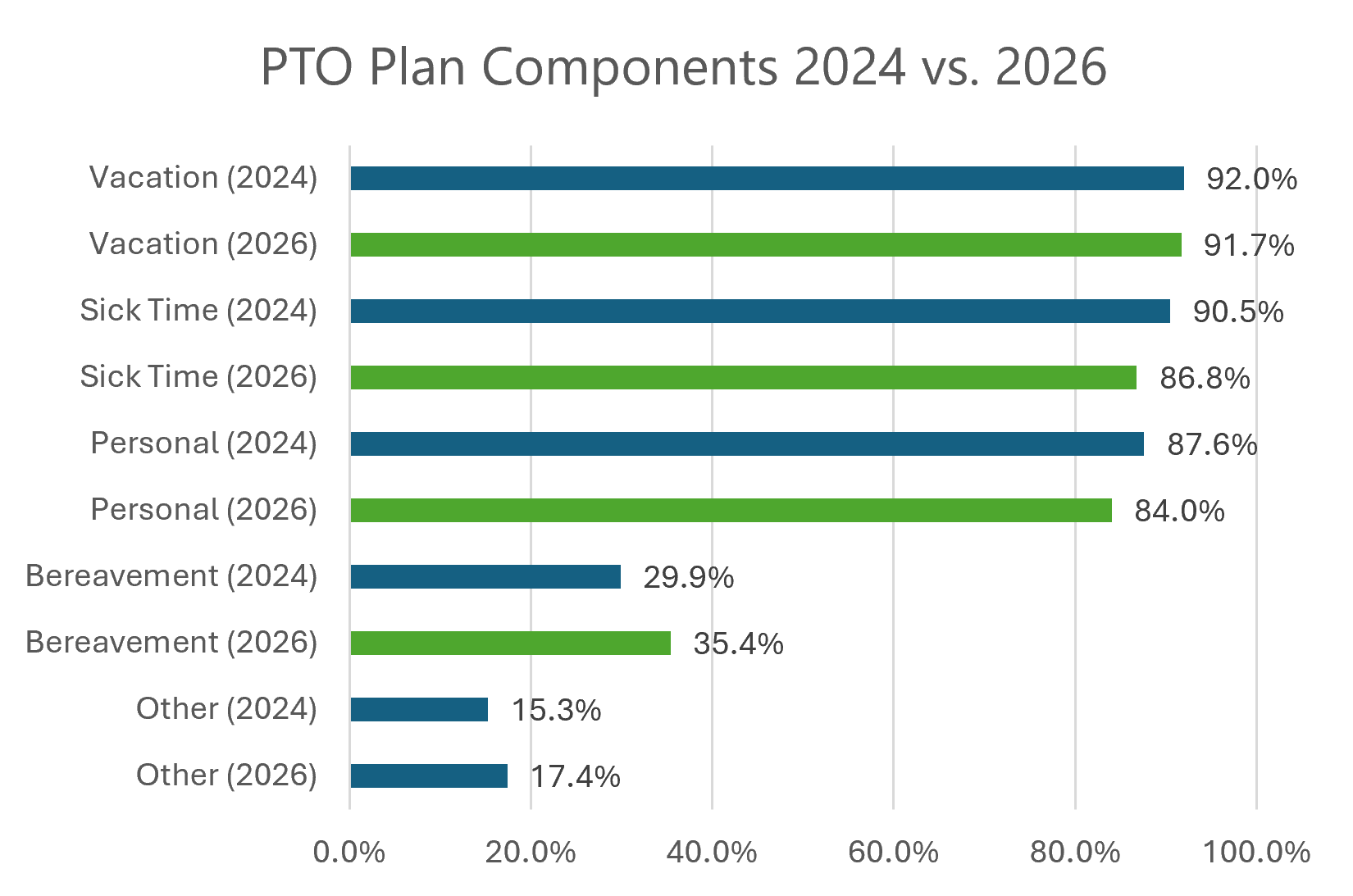
Among the write-in responses for “Other”, the most common additions were volunteer/community service leave, birthday leave, floating holidays, and jury duty. A smaller number of institutions also reported including parental leave, military leave, and wellness leave as part of their PTO program offerings.
How Banking Institutions Administer PTO
Among institutions offering PTO, 56.2% make full-time officers eligible immediately upon hire, slightly higher than 52.5% for full-time non-officers. Most institutions determine annual PTO based on length of service (78.7% for officers and 87.7% for non-officers), while relatively few use organizational level or prior experience.
In addition, 68.1% of participating institutions allow employees to carry over a portion of their unused PTO to the following year, with an average limit of 13 days.
PTO Program Administration at a Glance | |
| PTO Administration Practice | 2026 |
| Full-time officers eligible immediately upon hire | 56.2% |
| Full-time non-officers eligible immediately upon hire | 52.5% |
| PTO based on length of service (officers) | 78.7% |
| PTO based on length of service (non-officers) | 87.7% |
| Employees may carry over some unused PTO to the following year | 68.1% |
| Average maximum PTO carryover | 13 days |
Designing a Program for Bank Workforces
As PTO programs become more common, there is no one-size-fits-all approach to designing a program. Institutions should consider not only which types of leave to include, but also how the program aligns with their workforce, organizational culture, and business objectives.
The variety of responses included in the “Other” category illustrates how institutions structure PTO programs in different ways, reflecting the unique needs and priorities of each organization.
While PTO programs are the most common leave structure among participating institutions, separate vacation and sick leave programs remain widely used. To reflect these different approaches, the survey includes data on both PTO programs and traditional vacation and sick leave policies.
As benefit programs continue to evolve, benchmarking against peer institutions can help banks assess whether their PTO policies remain competitive and aligned with current market practices. Understanding how comparable organizations structure these programs provides valuable context when reviewing or updating internal policies.
Survey Methodology
To learn more about banking PTO programs and other employee benefit practices, the complete 2026 Banking Benefits and Human Resources Policies Survey is available exclusively from Pearl Meyer. The biennial survey included over 500 questions on benefits, perquisites, and HR policies, answered by 242 participating banks and credit unions. All reported data reflect responses only from institutions that offer a particular benefit, perquisite, or program. Additional information, including the data reported and participating organizations, is available in the survey prospectus.